Alight Motion System Requirements 2026 | Complete Guide for Android, iOS, PC, and Mac
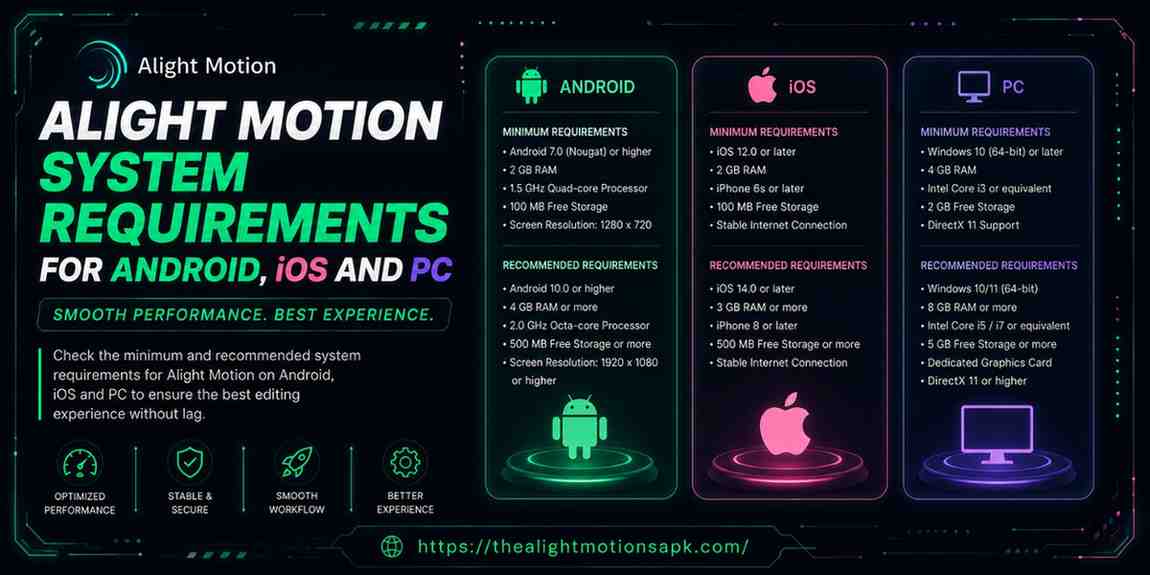
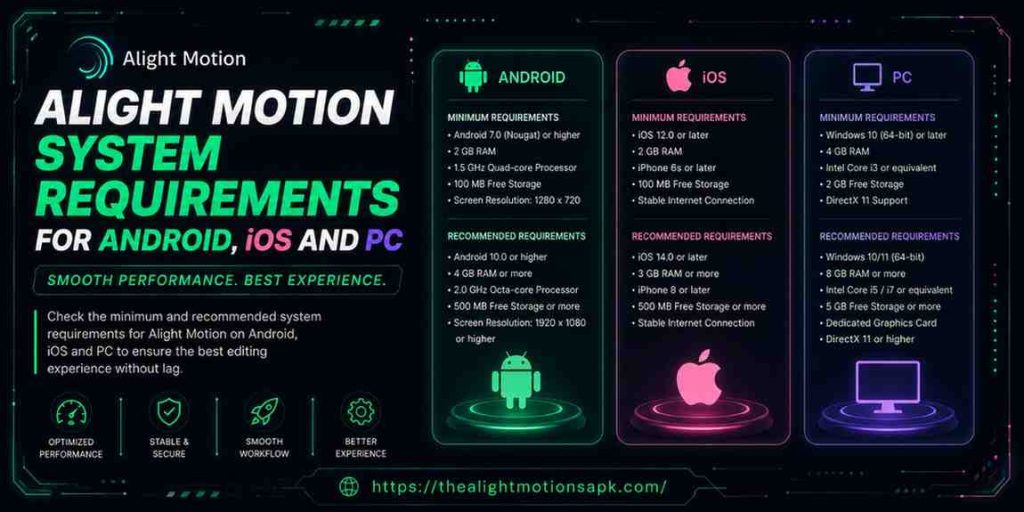
If you’ve ever installed Alight Motion System Requirement only to watch it freeze on launch or take forever to export a simple clip, you’re not alone. This app is genuinely powerful, but it’s also demanding and most performance complaints come down to one thing: the device simply isn’t built for what Alight Motion is asking it to do under the Alight Motion System Requirements guidelines.
This guide breaks down exactly what hardware and software you need, platform by platform, so you don’t waste time guessing.
What Exactly Is Alight Motion?
Alight Motion is a mobile-first motion graphics and video editing app built by Alight Creative Inc. It packs in features normally reserved for desktop tools like After Effects keyframe animation, multi-layer compositing, vector graphics, blend modes, color grading, and 4K export all running on a phone.
It’s especially popular among content creators, reel editors, and motion designers, with a particularly strong following across South Asia.
Core features include:
- Multi-layer timelines supporting video, audio, images, and effects
- Keyframe-driven animation
- 100+ blend modes and visual effects
- Vector drawing and shape tools
- High-resolution (4K) export
- Shareable XML project files for templates
- Free download on Play Store/App Store (watermarked exports unless subscribed)
Why Hardware Compatibility Actually Matters?
Because Alight Motion processes everything layers, effects, color, motion in real time, it leans heavily on your processor, RAM, and GPU. Run it on underpowered hardware and you’ll deal with stutters, failed exports, or outright crashes. Checking your specs first saves a lot of frustration later.
Why Specs Affect Editing Speed and Stability?
Each added layer or effect increases the real-time processing load. On a device that meets the recommended specs, a short 30-second project with 5-6 layers typically exports in under a minute. On underpowered hardware, that same export can take 5-8 minutes, or fail completely.
Typical symptoms of insufficient hardware:
- Crashes right after opening a project
- Timeline playback stuttering
- Exports that silently fail
- App not showing up in the Play Store/App Store
- App installs but won’t launch
None of this is a bug it’s simply the app exceeding what the hardware can handle.
Android Requirements
Android is Alight Motion’s home platform it was built here first and gets the most consistent updates.
Minimum vs Recommended Specs
| Spec | Minimum | Recommended |
| OS Version | Android 6.0 (Marshmallow) | Android 8.0+ |
| RAM | 1.5 GB | 3 GB+ |
| Free Storage | 1.5 GB | 3 GB+ |
| Chipset | Any mainstream SoC | Snapdragon 660 / Helio G85 or better |
| GPU | OpenGL ES 3.0 | Adreno 512 / Mali-G72 or better |
| Internet | Needed for setup | Stable connection for sync |
For heavier work multi-layer projects, 4K renders, dense keyframe animation aim higher: 4 GB RAM, a Snapdragon 700-series chip (or equivalent), and 4 GB+ free space. Phones like the Galaxy A54, Redmi Note 12 Pro, or Realme 10 Pro handle this comfortably.
What’s Supported?
- Any Android phone/tablet on Android 6.0+
- Android tablets (features all work, though the UI isn’t tablet-optimized)
- Chromebooks with Play Store/Android app support
- Snapdragon, MediaTek, Exynos, and Kirin chipsets
What’s Not Supported?
- Devices on Android 5.x or older
- Chipsets from Marvell, Spreadtrum, or Rockchip
- Rooted devices or sideloaded APKs (not officially supported, and risky stick to the Play Store)
A Note on Storage
Alight Motion generates temporary cache files during editing anywhere from 500 MB to 1.5 GB per session depending on project complexity. Keep at least 3 GB free at all times, and clear the app’s cache weekly if you edit often.
iOS Requirements
Thanks to Apple’s tight hardware/software integration, Alight Motion tends to run smoothly even on older iPhones.
Minimum vs Recommended Specs
| Spec | Minimum | Recommended |
| OS Version | iOS 14.4 | iOS 16+ |
| Device | iPhone 6S / iPod Touch 7 | iPhone 8 or newer |
| RAM | 2 GB | 3 GB+ |
| Storage | 2 GB | 4 GB+ |
| Chip | A9 | A12 Bionic or newer |
| iPad | 7th-gen + iOS 14.4 | iPad Air 4 / iPad Pro |
For serious work 4K, multiple layers, custom effects an iPhone 11 (A13) or newer is the sweet spot under Alight Motion System Requirement, and on iPad, any iPad Pro generation performs best.
Device-by-Device Breakdown
iPhones
- iPhone 6S – runs, but lags on heavier projects
- iPhone 7/8 – fine for light-to-medium work
- iPhone X/XS/XR – solid, reliable performance
- iPhone 11 through 16 – full feature set, no compromises
iPads
- iPad 7th gen and later – fully supported
- iPad Air 3rd gen and later – strong performance
- iPad Mini 5th gen and later – compact, capable
- iPad Pro (any gen) – best iOS experience available
iPod Touch
- 7th gen – minimum supported, limited on heavy projects
- 6th gen and earlier – not supported
Not Supported
Anything that can’t run iOS 14.4 including the iPhone 5s, iPhone 6, older iPads, and iPod Touch 6th gen or earlier.
A Tip Worth Knowing
Once you’re on an A12 Bionic chip or newer, the difference is night and day faster renders, instant previews, no stutter. On an iPhone 6S/7, you’ll feel the strain past 3-4 stacked layers with effects. A simple habit that helps: restart your iPhone before a long editing session to clear memory.
Android vs iOS: Which Actually Performs Better?
It’s less about the platform and more about the specific device.
- A flagship Android phone (Galaxy S24, OnePlus 12) will beat an older iPhone 8.
- But a newer iPhone (like the 13) will usually outperform a mid-range Android phone even one with more RAM on paper because iOS handles memory more efficiently for this kind of workload.
| Tier | Best Android Pick | Best iOS Pick |
| Budget | Redmi Note 12 (4 GB) | iPhone SE 2022 / iPhone 8 |
| Mid-range | Galaxy A54 5G | iPhone 12 |
| Flagship | Galaxy S24 / OnePlus 12 | iPhone 14 Pro / 15 Pro |
Running Alight Motion on Windows PC
Under Alight Motion System Requirement, there’s no native Windows build no installer, no .exe. The only way to use it on a PC is through an Android emulator.
How It Works?
- Install an Android emulator (BlueStacks, LDPlayer, or NoxPlayer)
- Sign in with a Google account
- Install Alight Motion from the Play Store inside the emulator
- Use it exactly like the mobile version same features, full functionality
Minimum PC Specs
| Spec | Minimum |
| OS | Windows 7 (64-bit) |
| RAM | 4 GB |
| Storage | 5 GB free |
| CPU | Dual-core, 2.2 GHz |
| GPU | DirectX 11 / OpenGL 2.0 |
| Internet | Broadband |
Recommended PC Specs
| Spec | Recommended |
| OS | Windows 10/11 (64-bit) |
| RAM | 8 GB+ |
| Storage | SSD, 10 GB+ free |
| CPU | Core i5 8th-gen / Ryzen 5 3600 or better |
| GPU | GTX 1050 or equivalent |
| Virtualization | Intel VT-x / AMD-V enabled |
The emulator layer does add some overhead load times and large exports take slightly longer than on native Android but with an SSD and 8GB+ RAM, the bigger screen makes detailed timeline editing genuinely easier.
Best Emulators
- BlueStacks 5: widely used, good Play Store integration, best for high-end PCs
- LDPlayer: lighter on resources, great for mid-range machines
- NoxPlayer: decent backup, but slower update cycles
Based on real testing: LDPlayer for mid-range hardware, BlueStacks 5 for stronger machines.
Running Alight Motion on Mac
Apple Silicon Only
Mac support comes through the iOS app framework and only on Apple Silicon Macs (M1 and later). Intel Macs cannot run it.
Minimum:
- Chip: M1 or later
- macOS: 12 Monterey+
- RAM: 8 GB unified memory
- Storage: 5 GB free
Recommended:
- Chip: M2 or M3
- macOS: 14 Sonoma+
- RAM: 16 GB unified memory
- Storage: 20 GB+ SSD
Linux and Chromebook Support
Chromebooks that support Android apps via Play Store can run Alight Motion natively most modern models do, and 4 GB+ RAM is recommended for a smooth experience.
Linux has no native or official support. Workarounds exist using Anbox or Android-x86 virtual machines, but performance is inconsistent treat this as an advanced experiment, not a reliable setup.
Neither platform matches the stability of Android or iOS, and GPU-accelerated rendering may not behave correctly on either.
Other Mobile Platforms
Alight Motion isn’t available on Windows Phone, BlackBerry OS, KaiOS, or HarmonyOS (without Android app support) these are either discontinued or simply unsupported by Alight Creative. Outside Android, iOS, and Apple Silicon Macs, there’s no official client. Treat any other “version” as unofficial and avoid it.
Quick Reference Summary
| Platform | OS Requirement | RAM | Notes |
| Android | 6.0+ | 1.5 GB min / 3 GB rec | Native, best supported |
| iOS | 14.4+ | 2 GB min / 3 GB rec | iPhone 8+/A12+ ideal |
| Windows | Win 7+ (via emulator) | 4 GB min / 8 GB rec | No native version |
| macOS | Monterey+ | 8 GB min | Apple Silicon only |
| Chromebook | Android app support | 4 GB rec | Native via Play Store |
| Linux | – | – | Unofficial workaround only |
How Much Storage Do You Actually Need?
The app itself is small roughly 200-350 MB on Android, 300-500 MB on iOS. The real storage usage comes from project work:
| Scenario | Storage Needed |
| App install only | 200-500 MB |
| One standard project (30 sec, 4-5 layers) | +500 MB to 1 GB |
| Multiple active projects | 2-4 GB ongoing |
| One 4K export (1 minute) | 500 MB to 1.5 GB |
| Recommended free space, always | 3 GB minimum |
For heavier, longer projects with multiple 4K exports, keep 8-10 GB free as a safer buffer.
Tips to Improve Performance
Reduce lag:
- Drop preview resolution to 50-75% while editing (export at full quality later)
- Avoid stacking more than 3-4 blur/glow effects at once
- Break large projects into smaller segments
Manage storage:
- Clear cache regularly via Settings > Apps > Alight Motion > Storage (Android)
- Reinstall periodically on iOS if cache buildup slows things down
- Keep 3 GB+ free at all times
Free up RAM:
- Close all background apps before opening Alight Motion
- On Android, clear the recent apps tray; on iOS, swipe up to close unused apps
Match export settings to your device:
- 720p/1080p if you have under 3 GB RAM
- 1080p/4K only on recommended-spec devices
Common Problems and Fixes
App missing from the Play Store/App Store: Usually an OS version issue or regional restriction. Update your OS if possible, or check your store’s region settings.
Installation fails: Often caused by low storage or an interrupted download. Free up 2 GB+, ensure a stable connection, and retry. Pending system updates can also temporarily block installs.
App crashes or freezes: Typically low RAM, low storage, or an outdated app version. Close background apps, clear cache, update the app, and reinstall if the problem persists.
Slow exports or rendering: Usually too many effects or a device below recommended specs. Cut down layers, lower preview resolution, and enable GPU rendering in developer settings if your device supports it.
Emulator issues on PC: Check that virtualization (Intel VT-x/AMD-V) is enabled in BIOS, and allocate at least 4 GB RAM to the emulator. Switching from HDD to SSD usually gives the single biggest speed boost.
Frequently Asked Questions
Does it work on Android 5?
No Android 6.0 is the hard minimum.
How much RAM is really needed?
Officially 1.5 GB (Android) or 2 GB (iOS), but for smooth multi-layer editing, 3-4 GB is what you actually want.
Does it work on iPad?
Yes, on iOS 14.4+. The interface isn’t tablet-optimized, but every feature works and iPad Pro performs especially well.
Can I run it on Windows without an emulator?
No there’s no native Windows build. An emulator is required.
Is it available on Mac without an emulator?
Yes, but only on Apple Silicon Macs (M1+), via the iOS app. Intel Macs aren’t supported.
Can a low-end phone run it?
Technically, if it meets minimum specs but expect slower exports and choppy previews. A mid-range device is strongly recommended for anything beyond basic edits.
Best processor to look for?
Android: Snapdragon 700-series or higher. iOS: A12 Bionic or newer. PC: Core i5 8th-gen / Ryzen 5 or better.
How much storage for big projects?
Keep 8-10 GB free if you’re doing multiple long projects or 4K exports regularly.
Conclusion
Getting smooth performance out of Alight Motion isn’t complicated it just starts with understanding the Alight Motion System Requirement and matching the app to the right hardware:
- Android: 6.0+, 3 GB RAM recommended, 3 GB free storage
- iOS: 14.4+, iPhone 8/A12 Bionic or newer is the sweet spot
- Windows: Emulator required (LDPlayer or BlueStacks 5), 8 GB RAM ideal
- Mac: Apple Silicon only Intel Macs won’t work
- Chromebook: Works natively if Android apps are supported
If you’re right at the minimum spec line, the performance tips above (lower preview resolution, regular cache clearing, closing background apps) will make a real difference, especially when you’re comparing Alight Motion vs Remini and noticing how differently both apps handle performance on the same device.