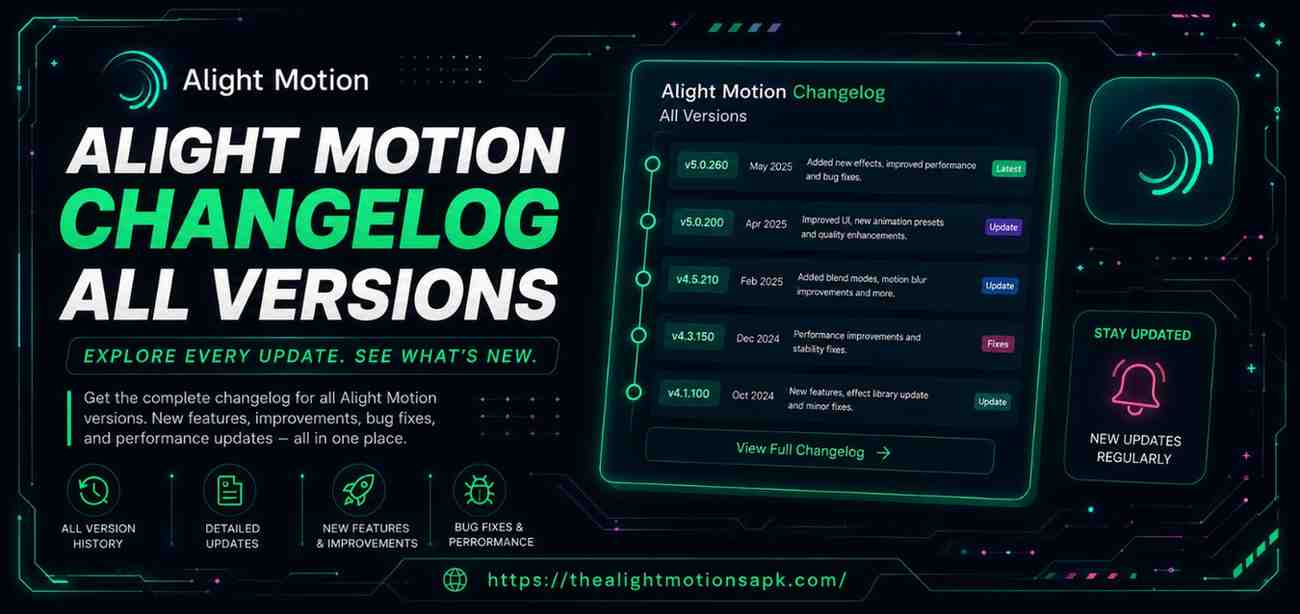
Alight Motion Changelog All Versions (2016-2026) | Every Update You Need to Know
If you’ve been using Alight Motion for even a few months, you already know that feeling you open the app one morning, see “Update Available,” and you’re not sure whether to tap it or leave things exactly as they are. Because the last time you updated, your favorite Alight Motion Presets stopped working. Sound familiar?
I’ve been there too. Over the years, I’ve gone through almost every version of Alight Motion from the early 3.x days when easing curves felt like a superpower, all the way to the current 5.0.273 build. I’ve seen features appear, disappear, and come back better than before. And through all of that, one thing became clear: understanding the Alight Motion changelog all versions is not just for tech nerds it’s for anyone who takes their editing seriously.
This guide covers the complete Alight Motion version history from 2016 to 2026, what changed in each major update, which version to use based on your phone and skill level, and answers to the questions I get asked most often by editors across India, Pakistan, Bangladesh, and beyond.
What Is Alight Motion Changelog and Why Should You Care?
What Does a Changelog Actually Mean?
A changelog is basically the app’s own diary a record of everything that was added, fixed, or removed in each new version. When Alight Motion releases an update, the changelog tells you exactly what changed: a new effect, a bug fix, a performance improvement, or sometimes, the removal of a feature people loved.
For casual users, it’s easy to ignore. But for serious video editors people making reels, YouTube intros, lyrical videos, or motion graphics the changelog is everything. It tells you whether you should update now or wait.
Why Indian and South Asian Creators Rely on Alight Motion Updates?
Alight Motion has a massive user base across India, Pakistan, Bangladesh, Sri Lanka, and Nepal. The reason is simple: it gives professional-level motion graphics tools for free (or at low cost) on Android phones phones that many creators here actually own.
When a new version drops with something like Chroma Key or AudioMixer, it’s a big deal for a creator in Lucknow making music lyric videos or a designer in Lahore building brand reels. Every update in the Alight Motion changelog all versions list has real-world impact for this audience.
How Each Update Changed the Way We Edit?
Every major version of Alight Motion brought something that changed how editors actually worked. Version 3.3.4 gave us proper easing curves suddenly motion felt alive instead of robotic. Version 4.4.0 brought Motion Tracking something previously only possible on desktop apps. Version 5.0 restructured the whole platform. Each of these wasn’t just a feature drop it was a shift in what was possible on a mobile device.
A Brief History of Alight Motion
The Beginning – 2016
Alight Motion APK was first released in May 2016 by Alight Creative, Inc. At the time, it was one of the very few apps that attempted to bring keyframe-based animation to mobile devices. Version 1.0 was barebones but it proved something important: professional motion graphics on a phone was possible.
Back in 2016, I remember trying it on a mid-range Android and thinking, “This is interesting, but limited.” What I didn’t know was that the team would spend the next ten years building it into something genuinely powerful.
How the App Evolved into a Professional Motion Graphics Tool?
The jump from Version 1.0 to where we are in 2026 is enormous. What started as a basic keyframe editor now supports 3D compositions, Duik rigging, motion tracking, chroma key, audio mixing, LUT-based color grading, and Bezier curve control features that used to require Adobe After Effects on a desktop computer.
That evolution happened version by version, update by update which is exactly why the Alight Motion changelog all versions record matters.
Alight Motion Version Timeline at a Glance
| Era | Versions | Years | Key Theme |
| 1.x | 1.0 | 2016 | Initial launch |
| 2.x | 2.0 – 2.8 | 2018-2019 | Foundation and stability |
| 3.x | 3.1 – 3.10 | 2020-2021 | Feature explosion |
| 4.x | 4.0 – 4.5.12 | 2021-2023 | Professional tools |
| 5.x | 5.0.0 – 5.0.273 | 2023-2026 | Modern platform |
Version 1.0 – Where It All Began (2016)
Released in May 2016, Alight Motion 1.0 introduced the core concept: a multi-layer, keyframe-based video editor on mobile. It supported basic bitmap and vector layers, simple animations, and limited export options.
It wasn’t polished. It wasn’t powerful. But it planted the seed.
For context in 2016, most mobile video editors were basic cut-and-trim tools. The idea of keyframe animation on a phone was genuinely new.
Alight Motion 2.x Changelog | The Foundation Era (2018-2019)
Version 2.0 – The App That Started Everything (2018)
Version 2.0 was essentially the relaunch. The team rebuilt a lot of the interface, improved layer management, and introduced more stable export options. For many users, this was their first encounter with Alight Motion because the app had started spreading through editing communities in India and Southeast Asia around this time.
I started seriously using Alight Motion around 2.x mostly for simple logo animations. The interface felt manageable, and the keyframe system was already better than anything else on mobile at the time.
Versions 2.2 to 2.8 – Fixing, Polishing, Getting Serious (2018–2019)
The 2.x series was mostly about stability. Effect rendering got faster. Crashes became less frequent. Export quality improved. These were not glamorous updates, but they built the trust that made creators stick with the app.
By Version 2.8, Alight Motion had a loyal base of editors who believed in its potential even if it hadn’t fully delivered yet.
Alight Motion 3.x Changelog | The Feature Explosion (2020-2021)
The 3.x era is where Alight Motion went from “promising app” to “actually useful for professional work.” This is the era most long-term users remember fondly.
Version 3.1.4 – When Effects Got Real (March 2020)
Version 3.1.4 significantly expanded the effect building block system. Instead of fixed, preset-only effects, creators could now stack and combine effect modules. This was the first time Alight Motion felt genuinely creative rather than template-based.
For lyrical video makers and reels editors, this was massive.
Version 3.2.1 – Demo Mode Arrives
This version introduced Demo Mode a way to preview and share effects without full subscription access. It also brought several effect refinements that made the visual output cleaner and more professional.
Version 3.3.4 – Easing Curves Changed Everything (June 2020)
This is the version I remember most clearly from the 3.x era. Easing curves the ability to control exactly how a keyframe accelerates and decelerates made motion feel human and intentional rather than mechanical.
Before 3.3.4, animations in Alight Motion had that “robotic” feel. After 3.3.4, you could create smooth, organic motion that actually looked good. This single feature changed what was possible in mobile motion graphics.
Version 3.4.2 – Vector Keyframes and New Shapes
Vector keyframes meant that shape paths themselves could now be animated morphing from one form to another over time. Combined with new shape tools, this opened up an entire category of animation that mobile editing had never really supported before.
Version 3.4.3 – Project Packages Made Sharing Easy
Project Packages allowed creators to export and share entire project files including assets, effects, and settings in a single file. This one feature created an economy of shared presets and templates across the Alight Motion community. If you’ve ever downloaded an AM preset pack, this is the version that made that culture possible.
Version 3.5 – Streak Effects and Better Audio
Streak effects became a visual signature of Alight Motion content during this period that glowing light trail effect you see on lyrical videos everywhere. Version 3.5 also improved audio handling, which mattered a lot for music-based content.
Version 3.6 – Hex Tiles and Effect Polish
According to the Alight Motion Changelog, Version 3.6 added Hex Tile effects and refined the broader effect system. More importantly, general stability improved significantly, making the app reliable enough for creators who were starting to use it for client work.
Version 3.7.1 – Stability Comes First
Sometimes the most important update is the boring one. Version 3.7.1 focused on crash fixes, performance improvements, and workflow smoothness. After the rapid feature additions of earlier 3.x versions, the app needed this.
Versions 3.8 to 3.10 – Layer Parenting and Shape Layers
Version 3.9 introduced proper Shape Layers dedicated vector layers with full path control. Version 3.10 brought Layer Parenting the ability to link one layer’s movement to another which was a game-changing workflow feature that desktop compositing apps had offered for years. Getting it on mobile was a genuinely big deal.
Alight Motion 4.x Changelog | The Professional Era (2021–2023)
The 4.x era was when Alight Motion stopped being “the best mobile editor” and started competing with desktop tools for specific use cases.
Version 4.0 – Keyframe Interpolation and Camera Tools (November 2021)
Version 4.0 introduced proper Keyframe Interpolation controls, giving editors fine control over animation curves. It also added Camera system improvements that enabled more cinematic compositions. This was the update that made many After Effects users take mobile editing seriously for the first time.
Version 4.1 – 3D Compositions and Waveforms (April 2022)
3D Composition support arrived in Version 4.1 a major milestone. Layers could now exist in 3D space, enabling depth, parallax, and camera movement effects that previously required desktop software. The same version added audio Waveform visualization, which was genuinely useful for anyone syncing animations to music.
Version 4.2 – Collaboration, Masking, and Color Grading LUTs (June–October 2022)
The 4.2 series was packed with updates across several months. Collaboration tools let multiple users work on the same project. Masking tools improved significantly with Version 4.2.3. Color Grading LUT support arrived in 4.2.8 meaning you could apply the same professional color grades used in film production directly in Alight Motion. For content creators who cared about color, this was a big jump.
Version 4.3 – Chroma Key, Particle Effects, and AudioMixer (October-December 2022)
Chroma Key (green screen removal) in Version 4.3.4 was headline news for creators. Particle Effects in 4.3.3 added visual elements like rain, snow, sparks, and more. The AudioMixer in 4.3.5 gave editors multi-track audio control that rivaled desktop DAW basics. These three features together made the 4.3 series one of the most impactful update batches in Alight Motion’s history.
Version 4.4 – Motion Tracking and Geometry Effects (December 2022-February 2023)
Motion Tracking in Version 4.4.0 was the kind of feature that makes you stop and think about how far mobile editing had come. You could now track an object’s movement across a video and attach other layers text, graphics, effects to follow it automatically. Version 4.4.1 added Mask Tracking to complement this. Geometry Effects in 4.4.4 rounded out the series.
Version 4.5 – Duik Rigging and Advanced Keyframes (March-May 2023)
The 4.5 series was extraordinary. Version 4.5.0 brought Duik Rigging a character animation system used by professional animators worldwide to mobile for the first time. Onion Skinning (4.5.8) gave animators frame-by-frame reference visibility. Keyframe Waveforms (4.5.12) made animation timing visually intuitive. The 4.5 series was essentially Alight Motion saying: “We are a professional animation tool now.”
Alight Motion 5.x Changelog – The Modern Platform (2023–2026)
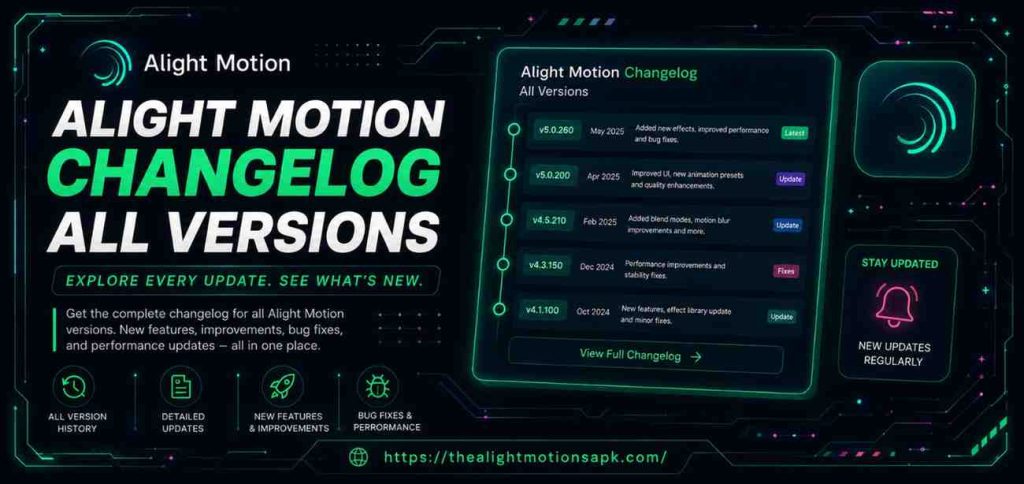
Version 5.0.0 – Layer Parenting Goes Pro (May 2023)
As highlighted in the Alight Motion Changelog, Version 5.0.0 rebuilt the Layer Parenting system with more robust parent-child relationship controls. This was the foundation of the entire 5.x platform restructure and marked a significant step forward in the app’s evolution.
Version 5.0.1 – Layer Styles (June 2023)
Layer Styles including drop shadows, glows, strokes, and fills arrived with 5.0.1. These are the kinds of non-destructive styling tools that After Effects users consider essential. Getting them on mobile was a genuine workflow improvement.
Version 5.0.2 – Keyframe Velocity Control (July 2023)
Fine-grained velocity control over individual keyframes. This gave animators a new level of precision over the timing and feel of their motion something only achievable before through workarounds.
Version 5.0.3 – Transform Anchor Points (August 2023)
Anchor Point control for transform operations. This resolved a long-standing workflow frustration where rotation and scaling didn’t behave predictably. Now you could set exactly where a layer rotates or scales from.
Version 5.1.0 – Bezier Handles and Control Points (August 2023)
Bezier curve handles came to Alight Motion in 5.1.0 giving animators the same curve control available in professional desktop animation tools. Combined with the Anchor Point and Velocity updates, this completed a professional-grade animation toolkit on mobile.
Version 5.0.62 – The Big Official Launch (June 2023)
The broader public rollout of the 5.x platform happened with 5.0.62. For most users, this was their first encounter with the new interface and feature set. First impressions were mixed the interface had changed enough that some longtime users needed adjustment time.
Versions 5.0.107 to 5.0.200 – Optimization and Stability (July–November 2023)
This period was about consolidation. Bug fixes, performance improvements, and refinements to features introduced earlier in the 5.x cycle. For creators on mid-range Android phones, these updates noticeably improved stability.
Versions 5.0.223 to 5.0.256 – New Enhancements (Late 2023–March 2024)
Versions in this range brought additional workflow enhancements, export improvements, and effect system refinements. Version 5.0.256 in March 2024 was particularly notable for performance gains on older devices.
Versions 5.0.270 to 5.0.272 – Late 2024 Improvements
These versions continued the steady improvement cycle targeted bug fixes, rendering optimizations, and minor feature additions that collectively made the app noticeably smoother.
Version 5.0.273 – Latest Release (2026)
The current build as of 2026. Version 5.0.273 represents the most stable and feature-complete version of Alight Motion to date. If you’re on a reasonably modern device (Android 8.0+ or iOS 14+), this is the version to use.
Every Major Feature Across All Alight Motion Versions
Keyframe Animation – The Heart of Alight Motion
Present since Version 1.0, but refined dramatically across every major update. By 5.x, the keyframe system supports velocity control, Bezier handles, easing curves, interpolation types, and waveform visualization a complete professional toolkit.
Layer Parenting and Rigging
Introduced in Version 3.10, massively expanded with Duik Rigging in 4.5.0, and rebuilt in 5.0.0. Layer Parenting is essential for complex animations where multiple elements need to move together.
Motion Tracking and Mask Tracking
Arrived in Version 4.4.0 and 4.4.1 respectively. These features made it possible to attach graphics to moving objects in video something only desktop tools could do before.
Chroma Key and Particle Effects
Chroma Key (4.3.4) enabled green screen compositing on mobile. Particle Effects (4.3.3) added dynamic visual elements. Together they expanded the storytelling possibilities significantly.
Audio Effects and AudioMixer
Basic audio handling existed from early versions, but the AudioMixer (4.3.5) and Audio Effects (4.5.5) created a proper multi-track audio workflow essential for music video and lyrical content creators.
3D Composition and Depth Control
3D Compositions arrived in Version 4.1 and have been refined through 5.x. They enable parallax motion, camera moves, and depth-based compositing that give mobile content a cinematic quality.
Color Grading, LUTs, and Color Corrector
Color Corrector arrived in 4.2.2. LUT support came in 4.2.8. Together these gave editors professional color control the same tools used in film and TV post-production.
Vector Drawing and Shape Layers
Shape Layers (3.9) and Vector Keyframes (3.4.2) together make Alight Motion a capable vector animation platform not just a video editor.
Export, Rendering, and GIF Support
Export capabilities have improved steadily across all versions. The 5.x era brought better rendering speeds, improved GIF export, and more codec options.
Which Alight Motion Version Should You Use in 2026?
Best Version for Beginners (India and South Asia)
Version 5.0.273 the latest version. The interface has improved enough that beginners can learn it without the overwhelm that earlier 5.x versions caused. Start here.
Best Version for Low-End Android Phones (2GB–3GB RAM)
If your phone struggles with 5.x, Version 4.3.x or 4.4.x tends to run well on devices with 2GB–3GB RAM. These versions have most professional features without the heavier resource requirements of 5.x.
Many creators in India and Pakistan running budget Redmi, Realme, or Tecno phones find Version 4.4 to be the sweet spot powerful features, manageable performance.
Best Version for Pro Editors and YouTubers
Version 5.0.27 no question. Bezier handles, Layer Styles, Velocity control, Mask Tracking, Chroma Key, AudioMixer everything is here. If you’re making content for YouTube, Instagram, or clients, this is your version.
Why Many Creators Still Prefer Older Versions?
The honest reason: subscription changes. Version 4.x had a different feature gating model that some creators preferred. Some effects available freely in older versions moved to paid tiers in 5.x. For creators working without a subscription, older versions sometimes offer more usable free features.
Common Problems After Updating – And How to Fix Them
App Crashing After Update
The most common cause is insufficient storage or RAM. Clear cache before updating. If crashing persists, uninstall and reinstall the new version rather than updating over the old one.
Export Errors and Rendering Failures
Export errors in 5.x often relate to project complexity too many high-resolution layers. Try reducing composition resolution first, then exporting. If that fails, restart the app and export again.
Effects or Presets Gone Missing
Some effects from 3.x or 4.x don’t render properly in 5.x projects. If you open an old project in a new version and effects look wrong, this is a known compatibility issue. Keep the original version installed for older projects.
Lag and Performance Drop on Older Phones
Disable real-time preview for complex compositions. Reduce project resolution during editing. Export in sections if the full project causes lag. These workarounds help on phones with 2GB–3GB RAM.
How to Safely Roll Back to an Older Version?
Download the APK for your preferred older version from a trusted source (avoid random APK sites they often bundle malware). On Android, enable “Install from Unknown Sources,” install the APK, and choose not to update when prompted. Note: older versions may not support projects created in newer versions.
Alight Motion vs Other Apps – Honest Comparison
Alight Motion vs CapCut
CapCut is faster for quick edits and has strong AI-powered features. Alight Motion wins for animation depth, keyframe control, and motion graphics. If you’re making short social content, CapCut is faster. If you’re building anything with custom animation, Alight Motion is the choice.
Alight Motion vs KineMaster
When comparing Alight Motion vs KineMaster, KineMaster is stronger for traditional video editing, including cuts, transitions, and multi-track timelines. Alight Motion beats it for anything involving animation, effects, or motion graphics. They serve different primary purposes, which is why the Alight Motion vs KineMaster debate often comes down to your editing needs.
Alight Motion vs Adobe After Effects
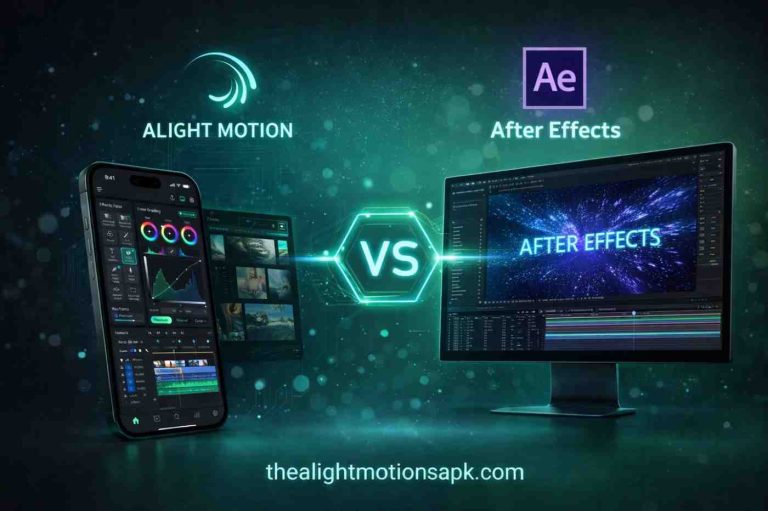
After Effects is the professional desktop standard. Alight Motion can’t fully replace it but it can do a surprising portion of what After Effects does, on a phone, for free or at low cost. For creators in South Asia who can’t afford After Effects subscriptions or don’t have access to high-end computers, Alight Motion is a genuine alternative for many common tasks.
Alight Motion vs VN Video Editor
VN is a clean, simple video editor. Alight Motion is a motion graphics platform. They’re not really competing they serve different needs. Many creators use both.
Alight Motion vs LumaFusion
LumaFusion is iOS-only and focused on professional video editing. Alight Motion is cross-platform and focused on motion graphics and animation. Different tools for different jobs.
Supported Devices and Platforms
Android Compatibility (Minimum Requirements)
- Minimum Android version: Android 5.0 (Lollipop) for older versions; Android 8.0 (Oreo) recommended for Version 5.x
- Minimum RAM: 2GB (3GB+ recommended for smooth performance on 5.x)
- Storage: At least 200MB free for the app, plus space for projects and exports
iOS Compatibility
Alight Motion is available on iOS. Version 5.x requires iOS 14 or later. Performance on iPhone is generally smoother than equivalent Android hardware due to iOS optimization.
PC and Emulator Support (BlueStacks etc.)
Alight Motion can run on PC through Android emulators like BlueStacks or LDPlayer. Performance varies. For editing work that requires precision input, using a mouse on emulator actually improves the keyframe workflow. This setup is popular among creators in India who don’t have access to dedicated desktop editing software.
FAQ’s
What is the latest version of Alight Motion in 2026?
As of 2026, the latest version is 5.0.273. It is the most stable and feature-complete release in Alight Motion’s history.
Which version is the most stable?
Version 5.0.273 for modern devices. Version 4.4.x for older or lower-end devices. Both have proven stable across a wide range of use cases.
Can I use older Alight Motion versions safely?
Yes, but with caveats. Older versions won’t receive security updates or bug fixes. Projects made in newer versions won’t open in older ones. For editing work, older versions are generally safe. Just be careful where you download APKs from.
What changed from version 4.5 to version 5?
Version 5.x rebuilt the core platform with a new interface, improved Layer Parenting, Layer Styles, Bezier handles, Keyframe Velocity, and Transform Anchor Points. The jump was significant enough that many longtime users needed adjustment time but the new platform is objectively more powerful.
Is Alight Motion free?
Alight Motion has a free tier with access to core features and some effects. A subscription (Alight Motion Pro) unlocks all effects, higher export quality, and watermark-free output. Pricing varies by region the annual subscription is generally affordable for creators in India and South Asia compared to alternatives like After Effects.
How often does Alight Motion update?
During active development phases, Alight Motion has released updates every few weeks. The 5.x era has maintained a steady cadence of incremental updates with occasional major feature releases.
How to downgrade Alight Motion version?
On Android, download the APK of your preferred older version, uninstall the current version (or install over it if you don’t mind potential conflicts), and install from the APK file. On iOS, downgrading is more restricted and requires accessing older builds through your purchase history if available.
Which version runs best on low-end phones?
Version 4.3.x or 4.4.x runs best on phones with 2GB–3GB RAM. These versions offer most professional features while being less resource-intensive than 5.x builds.
Conclusion
Looking back at the complete Alight Motion changelog all versions from the modest 1.0 launch in 2016 to the powerful 5.0.273 build in 2026 what stands out is how consistently and deliberately the app has evolved.
Every version added something meaningful. The 3.x era gave creators their first real motion graphics tools on mobile. The 4.x era brought professional features that genuinely changed what was possible. The 5.x platform rebuilt everything with a foundation that can support years of future development.
For creators across India, Pakistan, Bangladesh, and the broader South Asian editing community, Alight Motion has been more than an app it’s been the tool that made professional-quality content creation accessible without expensive hardware or software. That’s not a small thing.
If you’re just starting out, download the latest version and start with keyframes. If you’re on an older phone, stick with 4.4.x for now. And if you’ve been using Alight Motion for years you already know what this app has meant for your work.