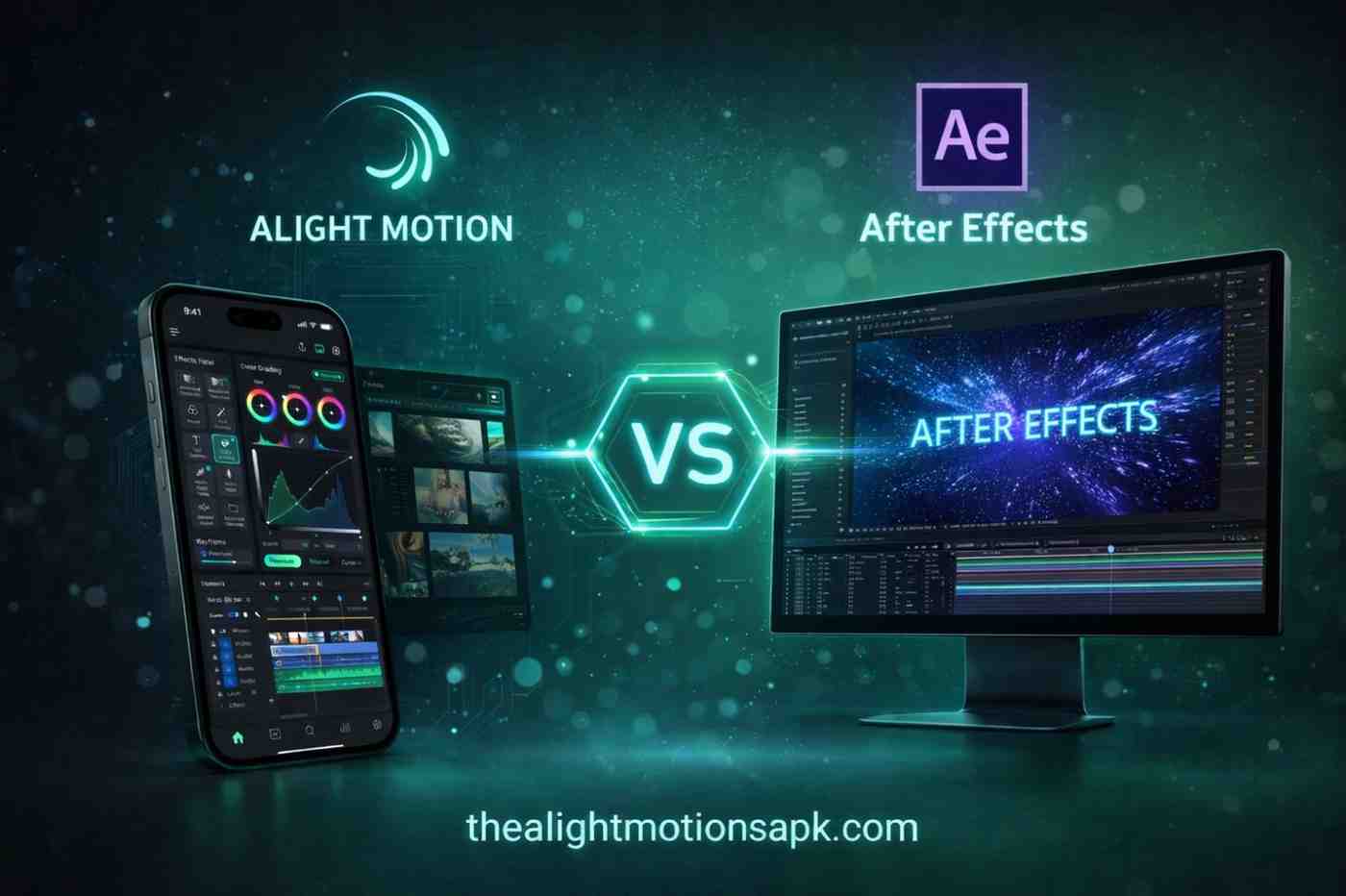
Alight Motion vs After Effects – Which Editor Is Better for Beginners and Professionals in 2026?
When I first started editing videos on my phone, I had no idea what I was doing. I downloaded Alight Motion after watching a few YouTube tutorials, and within a week, I was making smooth motion graphics that my friends thought were made on a computer, which is why many people often compare Alight Motion vs After Effects.
Then, as my projects grew more complex, someone told me to try Adobe After Effects. The first time I opened it, I honestly felt lost the workspace, the expressions, the plugins. It took me weeks just to understand the basics.
That personal experience is exactly why this comparison matters. Both tools are incredible but they serve very different people, at very different stages of their editing journey.
If you are a student in India, a content creator in Pakistan, or a freelancer anywhere across South Asia trying to decide between Alight Motion and After Effects, this guide will give you a clear, honest answer based on real usage not just specs and feature lists.
Quick Overview of Alight Motion and Adobe After Effects
What Is Alight Motion?
Am Mod is a professional-grade mobile editing app developed by Alight Creative, Inc. It runs on Android and iOS, which means you can create motion graphics, kinetic text, and layered video compositions right from your phone no laptop needed. For millions of creators across India, Bangladesh, and Pakistan, this is a game-changer because high-end editing no longer requires expensive desktop hardware.
The app first launched in 2017, and since then it has grown into one of the most popular video editing tools among mobile creators. It supports vector graphics, keyframe animation, multiple layers, visual effects, and audio mixing all from a touchscreen.
What Is Adobe After Effects?
Adobe After Effects is a desktop software by Adobe Systems, designed specifically for motion graphics, visual effects (VFX), and compositing. It has been the industry standard for professional VFX work since the mid-1990s. Broadcast studios, Hollywood productions, advertising agencies, and top-tier YouTube channels all use After Effects in their production pipeline, especially when discussing Alight Motion vs After Effects comparisons in terms of professional capability and mobile editing limitations.
After Effects is part of the Adobe Creative Cloud ecosystem, meaning it integrates directly with Premiere Pro, Photoshop, Illustrator, and Audition. This tight integration makes it the go-to tool for professionals who handle complex, multi-software workflows.
Main Purpose and Target Users
Alight Motion is built for mobile creators, social media editors, students, and beginners who want professional results without desktop software. After Effects is built for professional motion designers, VFX artists, studio teams, and advanced freelancers who need maximum creative control with no compromises.
The Alight Motion vs After Effects at a Glance
Quick Comparison Table
| Feature | Alight Motion | Adobe After Effects |
| Platform | Android & iOS (Mobile) | Windows & Mac (Desktop) |
| Best For | Beginners, Mobile Creators | Professionals, Studios |
| Learning Curve | Moderate | Steep |
| Price | Free / ~$2.99-$4.99/month | ~$54.99/month (Creative Cloud) |
| Keyframe Animation | Yes | Yes (Advanced) |
| Vector Graphics | Yes (Native) | Yes (via Illustrator) |
| Plugins/Scripts | No | Yes (Hundreds) |
| 3D Compositing | Limited | Full 3D Support |
| Export Quality | Up to 4K | Up to 8K+ |
| Internet Required | No | No (after installation) |
| Community Support | Large mobile community | Massive pro community |
Major Differences Between Both Editors
The most fundamental difference is simple: Alight Motion lives on your phone, After Effects lives on your computer. But beyond the device, the gap in production complexity is significant. After Effects supports expression-based scripting, which lets professionals automate animations using code. Alight Motion has no scripting support at all. On the other hand, Alight Motion lets you create a full motion graphics reel while sitting on a bus. After Effects requires you to be at a desk with a powerful machine.
Features Comparison Between Alight Motion and After Effects
Motion Graphics and Animation Tools
Both apps center around motion graphics, but they handle it very differently. Alight Motion uses a straightforward layer-based timeline. You add elements, set keyframes, and watch them animate. It is intuitive enough that most beginners figure it out within a few days of practice.
After Effects has a far deeper motion graphics system. You can create complex character rigs using the Puppet Pin tool, build reusable motion presets with Mogrts (Motion Graphics Templates), and even drive animations through audio levels or external data. For someone making a broadcast title sequence or a product launch video, After Effects gives complete creative freedom.
For simple social media animations and reels, Alight Motion is more than enough. For broadcast, commercial, or cinematic VFX, After Effects is the only real option.
Keyframe Animation Capabilities
Keyframe animation is the heart of both tools. In Alight Motion, you get Bezier curve controls that let you adjust the easing of each keyframe. This gives your animations a natural, smooth feel rather than robotic linear movement. For a mobile app, this level of keyframe control is genuinely impressive.
After Effects takes keyframe animation to another level entirely. You get the Graph Editor, which gives you visual control over every single aspect of motion. You can use Expressions (JavaScript-based code) to make keyframes react to other layers, to music beats, or to data inputs, which is one of the biggest differences highlighted in Alight Motion vs After Effects. Professional animators spend years mastering just this one part of After Effects.
If you need smooth, polished animations for Instagram Reels or YouTube Shorts, Alight Motion’s keyframe system handles it well. If you’re animating for a TV commercial or a film title sequence, you need After Effects.
Effects, Filters, and Visual Enhancements
Alight Motion includes a solid library of built-in visual effects glows, blurs, color overlays, distortions, and more. These effects are easy to apply and stack. Many creators in South Asia rely on these effects to create the trendy glitch, neon, and cinematic styles popular on Instagram and TikTok.
After Effects has thousands of built-in effects, plus access to the entire third-party plugin ecosystem tools like Video Copilot’s Element 3D, Red Giant Magic Bullet, and Trapcode Particular. These plugins alone can cost hundreds of dollars, but they produce results that are simply not achievable on any mobile app.
Layers, Masks, and Blending Options
Both tools support unlimited layers. In Alight Motion, you can group layers, lock them, and apply blend modes similar to how Photoshop handles layers. Masking is also supported, allowing you to hide or reveal parts of a layer using shapes or freehand paths.
After Effects has the same capabilities but goes much deeper. Track Mattes, Pre-compositions, and Adjustment Layers give professional editors tools to build incredibly complex visual hierarchies. The masking system in After Effects can even be automated using motion tracking.
Templates and Presets
One area where Alight Motion really shines for everyday creators is templates. The Alight Motion community especially across India, Pakistan, and Indonesia has built a massive library of free XML preset packs that you can import directly into your project. This shortcut lets beginners produce professional-looking videos within minutes.
After Effects also has templates, sold through platforms like Motion Array, Envato Elements, and VideoHive. These are more polished and complex, but they also cost money and require some knowledge to customize properly.
Text Animation and Typography Tools
Alight Motion supports custom fonts, kinetic text animation, and basic text effects. Many creators use it specifically for animated subtitles and titles for their videos.
After Effects has the most powerful text animation system in any editing software. You can animate individual characters, words, or lines. Text Animators allow dozens of parameters to be keyframed independently. For typography-heavy motion design work, nothing comes close.
User Interface and Ease of Use
Alight Motion User Experience
Alight Motion’s interface is clean, touch-friendly, and well organized. The timeline sits at the bottom, tools are on the left panel, and layer properties appear when you tap a layer. Everything is designed for a small screen, and it shows. Most new users feel comfortable navigating the app within their first hour.
The biggest challenge new users face in Alight Motion is understanding layers and keyframes. But once you watch a few tutorials, the logic becomes clear. The learning curve is moderate steep enough to be rewarding, easy enough not to be overwhelming.
Adobe After Effects Workspace
The first time most people open After Effects, they feel overwhelmed. The workspace has multiple panels Project, Composition, Timeline, Preview, Effects all open at once. Understanding the relationship between compositions, pre-comps, and footage items takes time. There is no hand-holding.
That said, After Effects has excellent built-in tutorials, and Adobe’s support documentation is thorough. Once you invest the time, the software rewards you with capabilities that no other tool can match.
Which One Has a Smaller Learning Curve?
Alight Motion wins here without any debate. A beginner can create their first animation in Alight Motion in under 30 minutes. A beginner in After Effects will likely spend weeks before creating anything that looks good. If you are just starting out, Alight Motion is the smarter starting point.
Mobile Editing vs Desktop Production
Portability and Accessibility
This is where Alight Motion completely dominates. You can edit on a bus, in a coffee shop, during lunch break, or anywhere you have your phone. There are no hardware requirements beyond a mid-range smartphone. For a college student in Mumbai or a content creator in Lahore, this accessibility is invaluable.
After Effects requires a laptop or desktop with at least 16GB RAM, a dedicated GPU, and a fast processor. It does not run on mobile at all. You need to be in one place, at one machine, with a proper setup.
Project Complexity and Production Scale
Alight Motion handles projects up to a certain level of complexity before things get complicated. Once you push past 15-20 layers with multiple effects, the timeline can get cluttered and the phone can start to struggle. It is not designed for 20-minute long-form video compositing.
After Effects handles Hollywood-level complexity. Multi-camera compositing, 3D scene integration, green screen keying, motion tracking on dozens of elements simultaneously After Effects manages all of this without breaking a sweat on a capable machine, which is exactly why it is often used as the benchmark in Alight Motion vs After Effects discussions.
Which Editor Fits Different Workflows?
If your workflow is: shoot on phone → edit on phone → post on Instagram → repeat, Alight Motion fits perfectly. If your workflow is: receive client brief → create storyboard → composite in software → export for broadcast → deliver to agency, you need After Effects.
Performance and System Requirements
Device Compatibility
Alight Motion runs on Android 5.0+ and iOS 13+. That covers almost every smartphone sold in the last five years across South Asia. Older budget phones can run it, though complex projects may lag.
After Effects requires Windows 10 (64-bit) or macOS 12 Monterey or later. Minimum 16GB RAM is recommended, with 32GB suggested for smooth performance. A dedicated GPU significantly improves rendering speeds.
RAM, Storage, and Hardware Requirements
| Requirement | Alight Motion | After Effects |
| RAM | 3GB+ phone RAM | 16GB–32GB PC RAM |
| Storage | ~150MB app size | 5GB+ installation |
| GPU | Built-in mobile GPU | Dedicated GPU recommended |
| OS | Android / iOS | Windows / macOS |
Stability and Rendering Performance
Alight Motion renders in real time on device, which can be slow on older phones. Complex projects with many layers and effects will lag during preview. After Effects renders using the CPU and GPU together, and with a good machine, it renders complex compositions in seconds. For large-scale projects, there is no comparison After Effects is faster.
Export Quality and Supported Formats
Resolution and Frame Rate Support
Alight Motion supports export up to 4K resolution at 60fps, which is more than enough for YouTube, Instagram, and most social media platforms. After Effects supports up to 8K resolution with frame rates up to 120fps, making it suitable for cinema and high-end broadcast work.
Available Export Formats
Alight Motion exports to MP4 (H.264/H.265), GIF, and PNG image sequences. After Effects exports through Adobe Media Encoder, supporting virtually every professional format: ProRes, DNxHD, H.264, H.265, EXR sequences, and more.
Rendering Speed Comparison
For a 30-second social media clip, Alight Motion exports quickly typically 1-3 minutes on a mid-range phone. After Effects rendering time depends on project complexity, but for the same 30-second clip with heavy effects, it can take 5-15 minutes without GPU acceleration, or under a minute with a powerful GPU.
Pricing and Subscription Plans
Alight Motion Pricing
Alight Motion offers a free version with watermarks on export. The premium subscription costs approximately $2.99 to $4.99 per month depending on the region, removing watermarks and unlocking the full feature set. For South Asian creators, this is very affordable.
Adobe After Effects Pricing
After Effects is available only as part of Adobe Creative Cloud. A single-app subscription costs approximately $54.99/month. The full Creative Cloud suite (which includes Photoshop, Premiere Pro, Illustrator, and more) costs around $59.99/month. This is a significant investment that not every creator can justify.
Free vs Paid: Which Offers Better Value?
For the average content creator or student, Alight Motion offers significantly better value at a fraction of the cost. For a professional who bills clients $500–$2000 per project, After Effects justifies its price through the output quality and speed it enables. It comes down to what stage of your career you are at.
Pros and Cons of Alight Motion
Advantages
- Works entirely on mobile no laptop required
- Very affordable compared to desktop software
- Large community with free presets and XML packs
- Beginner-friendly with a manageable learning curve
- Real-time preview without heavy hardware
- Great for social media content, Reels, and YouTube Shorts
- Active update cycle with new features added regularly
Limitations
- No scripting or plugin support
- Limited 3D capabilities
- Not suitable for complex, long-form production work
- Can lag on older or budget phones
- Project files are not easily transferable to desktop software
Pros and Cons of Adobe After Effects
Advantages
- Industry standard for professional motion graphics and VFX
- Thousands of plugins and third-party integrations
- Deep scripting and expression system for automation
- Full 3D compositing with camera tracking
- Integrates with the entire Adobe Creative Cloud suite
- Handles projects of any scale or complexity
- Used by every major studio, agency, and broadcast company
Limitations
- Very expensive over $600/year for a subscription
- Steep learning curve that can take months to overcome
- Requires powerful desktop hardware
- No mobile version exists
- Overkill for simple social media content
Real-World Use Cases and Best Applications
Social Media Content Creation
For daily Instagram posts, TikTok videos, YouTube Shorts, and Facebook Reels, Alight Motion is the better choice. It is fast, portable, and produces polished results that look great at 1080p on a phone screen. You do not need After Effects for a 30-second Reel.
Short Videos and Reels Editing
The preset and XML template culture around Alight Motion makes it exceptionally powerful for Reels. You can import a preset, swap out footage, change text, and export in under 10 minutes. That speed of production is something often highlighted in Alight Motion vs After Effects, where After Effects cannot realistically compete for this quick workflow use case.
Professional Motion Graphics Projects
If a client asks you to create a title sequence for a TV show, an animated logo for a brand launch, or a full product explainer video you need After Effects. The level of control, polish, and professional output simply cannot be replicated on a mobile app, no matter how good it is.
YouTube and Commercial Video Production
Mid-to-large YouTube channels that produce high-production-value content eventually move to After Effects for their intros, lower thirds, and visual effects. Agencies and commercial studios have no real alternative to After Effects for broadcast-quality work.
Who Should Use Alight Motion?
Beginners and Students
If you are new to video editing and you want to learn motion graphics without spending thousands of rupees on hardware and software, Alight Motion is the perfect starting point. You will learn keyframing, layering, and timing all the foundational skills that transfer to any other editing software.
Mobile Content Creators
Creators who shoot and edit entirely on mobile will find Alight Motion covers 90% of their editing needs. Reels, YouTube Shorts, cinematic montages, lyric videos all of this is achievable on Alight Motion.
Casual Video Editors
If you edit videos as a hobby or for personal projects birthday videos, travel montages, wedding slideshows Alight Motion gives you all the creative tools you need without the complexity of a professional platform.
Who Should Use Adobe After Effects?
Professional Motion Designers
If motion design is your career, After Effects is non-negotiable. Clients at the professional level expect After Effects output, and many project files and templates are built specifically for it.
Freelancers and Agencies
Freelancers who charge premium rates for motion graphics work, and agencies handling brand campaigns and broadcast production, depend on After Effects daily. The software’s output quality directly supports premium pricing.
Video Production Teams
Any studio or production team working on commercials, documentaries, films, or broadcast content will have After Effects in their toolkit. It is the industry standard for a reason nothing else comes close for high-end VFX work.
Safety, Reliability, and Future Updates
Regular Updates and New Features
Alight Motion releases updates regularly, adding new effects, improving stability, and responding to community feedback, which is an important point when looking at Alight Motion vs Remini in terms of how actively each app evolves. The development team is active and the app continues to grow in capability.
After Effects receives major updates annually as part of the Adobe Creative Cloud subscription. Adobe also releases performance patches and new features throughout the year, ensuring the software stays current with industry demands.
Legal and Security Considerations
Always download Alight Motion from the official Google Play Store or Apple App Store. Avoid any modified (MOD) APKs that promise unlocked features for free these carry real risks of malware, data theft, and account compromise. Pay the small subscription fee; it is worth it.
For After Effects, always use the official Adobe Creative Cloud installer. Pirated versions are not only illegal but also lack security updates and can damage your system.
Long-Term Reliability
Both tools are backed by strong organizations. Alight Creative continues to expand Alight Motion’s capabilities. Adobe has supported After Effects for nearly 30 years and shows no signs of stopping. Both are safe long-term investments in your editing journey.
Alight Motion vs After Effects Reddit Opinions
What Beginners Prefer?
On Reddit communities like r/VideoEditing and r/AlightMotion, beginners consistently praise Alight Motion for its accessibility. Common feedback: “I had no idea I could make something this good on my phone.” Indian and Pakistani creators in particular mention that the zero-hardware-cost entry point made video editing a realistic career path for them.
What Professional Editors Recommend?
Experienced editors on Reddit are clear: After Effects is the professional standard, and there is no mobile alternative for serious production work. However, many also acknowledge that Alight Motion is a legitimate gateway into motion design, and that skills learned there transfer well when you eventually move to desktop software.
Which Editor Is Better for Different Needs?
Best for Beginners
Alight Motion: Lower cost, mobile-friendly, strong community support, and manageable learning curve make it the obvious choice for anyone just starting out.
Best for Professional Editing
Adobe After Effects: No other tool matches its power, plugin ecosystem, and industry-standard output for professional motion graphics and VFX.
Best for Social Media Creators
Alight Motion: Speed, portability, and the vibrant preset community make Alight Motion the dominant tool for Instagram, TikTok, and YouTube Shorts creators.
Best for Freelancers and Agencies
Adobe After Effects: Professional clients, premium rates, and complex deliverables demand After Effects. It is the tool that justifies itself through the quality of work it enables.
Conclusion
According to our analysis in this Alight Motion vs After Effects comparison these two tools are not really competing with each other. They serve different people at different stages of a creative journey.
Choose Alight Motion if you are a student, a mobile-first creator, a beginner, or someone who produces content for social media platforms. It is affordable, accessible, and powerful enough to build a solid career in content creation.
Choose After Effects if you are a professional motion designer, a freelancer targeting high-paying clients, or part of a production team working on commercial and broadcast content. The investment in software and hardware pays for itself quickly once you are charging professional rates.
And if you are somewhere in the middle? Start with Alight Motion. Master the fundamentals. Build your portfolio. Then, when your projects outgrow your phone, you will know it is time to move to After Effects and you will be ready.
FAQ‘s
Is Alight Motion better than After Effects?
Not in terms of raw power or professional output After Effects is the more capable tool for complex work. But for mobile creators and beginners, Alight Motion is the better practical choice because of its accessibility and lower cost.
Can beginners learn Adobe After Effects easily?
After Effects has a steep learning curve. Most beginners take several weeks to months before feeling comfortable. Starting with Alight Motion first can actually help, since it teaches the same core concepts of keyframing and layers in a friendlier environment.
Is Alight Motion enough for professional editing?
For social media content, YouTube Shorts, and mobile-first production, yes. For broadcast, commercial, or cinema-level work, no After Effects is necessary at that level.
Which app is better for motion graphics?
Both handle motion graphics, but After Effects is the professional standard. Alight Motion is excellent for mobile-based motion graphics at the social media level.
Does After Effects work on mobile devices?
No. Adobe After Effects is a desktop-only application. There is no mobile version, and Adobe has not announced plans to build one.
Which editor offers better export quality?
After Effects supports higher resolutions and more professional export formats. However, Alight Motion’s 4K export is more than sufficient for all social media and YouTube use cases.
Is Alight Motion free to use?
Alight Motion has a free version, but it adds a watermark to exports. The premium subscription typically around $2.99 to $4.99 per month removes the watermark and unlocks all features.
Which software is best for YouTube creators?
For YouTube Shorts and channel intros on a budget, Alight Motion is excellent. For full production-quality YouTube videos with complex visual effects, After Effects is the better long-term investment.